Case study. Live
LeavePilot: building a product that handles employee data
Leave, time off and remote work days are data about people, managed by the same people who hold power over their employment. A system that touches them has to work well and pass two tests: the one set by the people using it every day, and the one set by whoever in the company has to show how that data is handled.
Written by Maximilian Giurastante. .
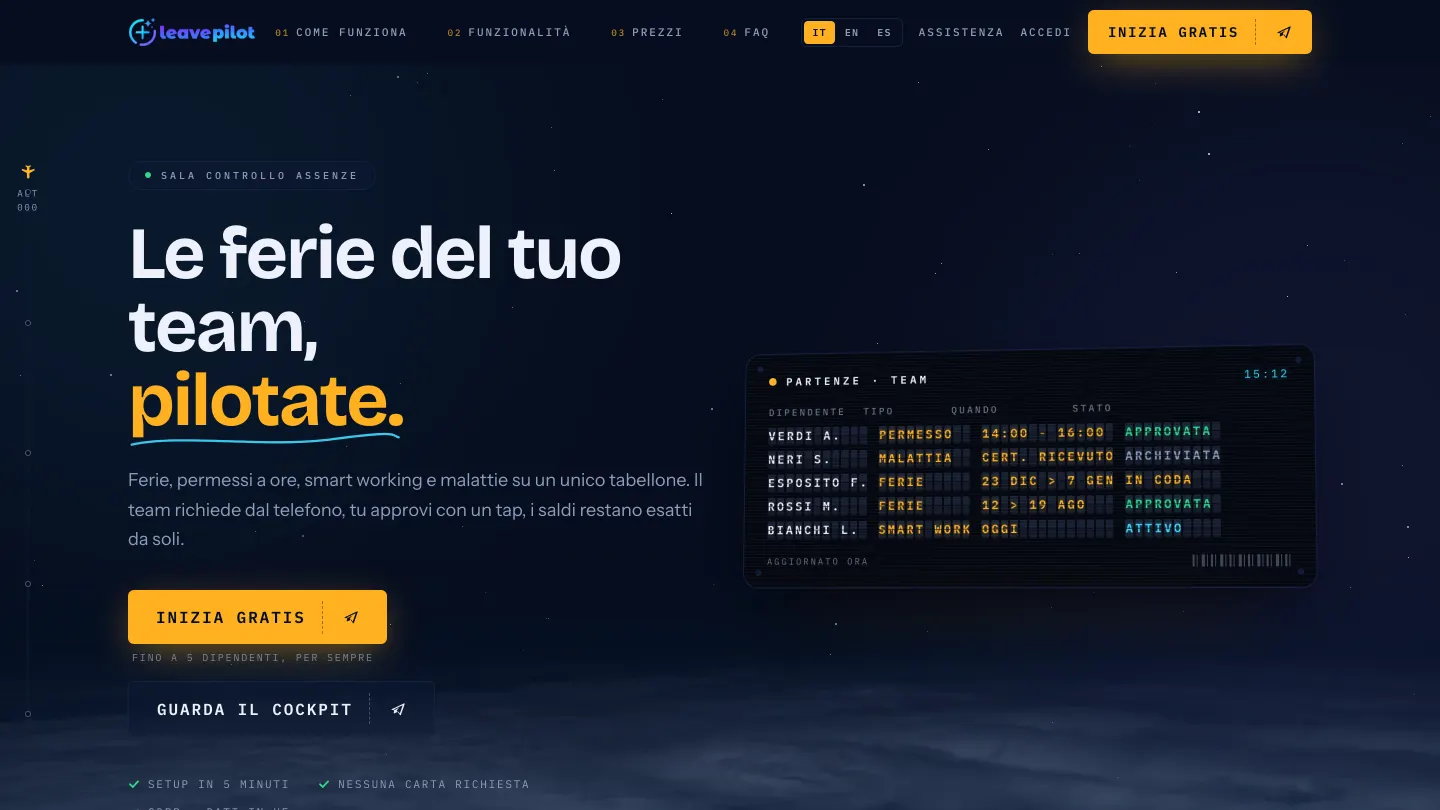
LeavePilot is a MAXYMIZE product for managing leave, hourly time off and remote work: shared calendar, requests with an approval flow, calculated balances, departments, public holidays by country and data export for payroll. Each company keeps its own data separate, the interface is available in Italian, English and Spanish, and the free plan covers up to five employees.
Project summary
- What it is
- A MAXYMIZE product of our own, sold by subscription
- Who it is for
- Companies from a handful of employees to a few hundred, with department managers and one administrator
- Origin
- Internal tool built for a company with several sites, August 2025
- From one company to a product for everyone
- March 2026: data kept separate per company, self-service sign-up, own domain
- Languages
- Italian, English and Spanish, including emails and legal documents
- Commercial model
- Free plan up to five employees, then a subscription per person; trial with no credit card
- Compliance
- Versioned contract documents with tracked acceptance, AI generated content marked as such
- Status
- In use, under continuous development; technical detail on the product page
The problem, which is not the calendar
In companies under a hundred people, absences are handled in a spreadsheet that only one person really knows, plus a trail of scattered messages. It works as long as that person is there and nobody disputes a total. The day someone does, there is no single place to look up who asked for what and who approved it.
Full HR systems solve the problem, but they are designed for much larger organizations: modules, licenses, long configurations. A company with fifteen people ends up paying for an oversized system it will use a small part of, or it stays with the spreadsheet. LeavePilot was born in that gap: do one thing, do it well, and cost little while the company is small.
What changes when the data belongs to a person
An absence is not a number like any other. It says when someone is away, sometimes because they are ill, and it is read by the people who decide about their career. That shifts the project: you need tight roles, a trail of the approvals, limited retention of sensitive documents, and a way for the client company to show an authority or an employee how the system works. These are requirements you design in at the start, or you never add them at all.
What it does, from the point of view of the people who use it
Three different people open the same application and have to find three different things there: the employee wants to ask for two days in ten seconds, the manager wants to know who is away next week, the administrator wants the numbers to be right at the end of the year.
How a request travels
Five step flow: request entered by the employee, notification to the manager, approval or rejection, balance updated, export for payroll. From approval or rejection the request goes back to the employee with the outcome.
- 1. Request: days or hours
- 2. Notification: to the manager
- 3. Decision: approve or reject
- 4. Balance updated: automatically
- 5. Export: for payroll
- Decision → Request (outcome to employee)
The features that real use made essential
- Hourly time off and remote work, not only whole days: it is the most frequent request and the one spreadsheets get wrong most often.
- Calculated balances with remaining days, adjustments and carry-over into the new year, instead of a total written by hand that nobody can trace back.
- Official public holidays by country, imported and updated every year: a company with people in several countries does not have to enter them by hand.
- Departments and managers, because in a company of forty people the administrator does not approve everything.
- Medical certificates stored encrypted and deleted when they expire, not left in a shared folder.
- Reports in PDF and spreadsheet form for whoever runs payroll, who is the real end recipient of the work.
What it takes to sell a product that handles other people's data
When a company hands its staff data to a supplier, it remains the data controller and answers for that choice. So the supplier has to deliver not only an application, but also the documents that let the company show it chose well. It is the part that makes a product take longer, and the part almost no price list talks about.
| What the client company asks for | How the product answers |
|---|---|
| A contract covering how the data is processed | A data processing agreement, versioned and accepted inside the application, with the date and the person who accepted it |
| Knowing which data is processed and for how long | Privacy notice and terms published by version, with earlier documents always available to read |
| Separation from other companies' data | Each company's data kept separate from the rest, not filtered out of a shared archive |
| Being able to say no to outside suppliers | No personal data goes to analytics tools without consent, with a switch per company |
| Knowing whether and where AI is used | One declared use, a comment on the summary reports, with generated content marked as such |
| That the AI produces no assessments of people | The model only receives aggregate numbers, never names; groups that are too small are merged beforehand |
Compliance work is not a separate formality: it changes the product. It decided what the language model can see, how long medical certificates are kept, which technical events can be collected and which cannot. A product built without those questions runs into them anyway, but at the first structured company that asks for the contract, when changing it costs ten times as much.
From internal tool to product
LeavePilot started in August 2025 as an internal tool for a single company with several sites. It became a product for anyone in March 2026. That step was not a matter of adding a sign-up screen: it meant rebuilding the foundations so that a second company could come in without seeing anything of the first.
- Separate data: each company has its own, and they do not live together in shared tables filtered on every query. It is the most expensive choice in the project, and the one that lets you answer the question "where is our data" in a single line. The comparison between the two possible models is in the note multi-tenant SaaS or separate instances.
- Self-service sign-up: a company registers, chooses its own address and starts, with nobody having to configure anything by hand.
- Customizable appearance: the company logo in the header and on the login page, because an employee has to recognize the tool as their own company's.
- Three languages everywhere, including automated emails and legal documents: a product sold in several countries cannot have a translated interface and its communications in one language only.
- A help center inside the application, with dozens of pages per language: in a product sold without salespeople, the documentation is part of the product.
Status and results
LeavePilot is in use and under continuous development. What we can state is the scope of the product; adoption figures are commercial data that we do not publish, and we do not invent percentages to fill the gap.
- 3
- languages, including emails and legal documents (Italian, English, Spanish)
- 5
- employees included in the free plan (with no time limit)
- 0
- personal data sent to the language model (the report comment works on aggregates)
- 13
- months from the first internal tool to a product for everyone (August 2025, March 2026)
What it teaches anyone who wants to build a similar product
A subscription product is not a client project with more clients. The questions it has to answer are different, and the hardest ones are not technical.
- Starting from a problem you know from the inside cuts months off the phase where you are guessing what is needed.
- How data is kept separate between clients has to be decided before the first table: after launch it is a rewrite.
- The contract documents and the privacy notice are as much part of the product as the screens, and they need versioning like the code.
- Languages and help documentation cost far less if they go in straight away, and far more if you add them later.
- Wherever a language model comes in, decide first which data it must never see.
If you are weighing up a subscription product of your own, the SaaS platforms page describes how we work and how we work and what it costs gives the orders of magnitude. The technical decisions behind LeavePilot, for anyone who wants the detail, are on the product page.
Technologies used
Choices made for a product that has to host different companies, cost little while a company is small and stand up to anyone who asks where their data is.
Application
- Web application
- Use from a phone
- Three languages
Data
- Data kept separate per company
- Sensitive documents encrypted
- Log of operations
Access
- Roles: employee, manager, administrator
- Sign-in with email and password
Operations
- Pay as you go infrastructure
- Dedicated address per company
Frequently asked questions
Which companies is LeavePilot designed for?
For companies that range from a handful of employees to a few hundred, with one or more departments and managers who approve the requests. Below five employees the free plan is enough and it does not expire. Above a few hundred you usually need the features of a full HR system, and we say so instead of selling the wrong tool.
Is my company's data separate from other companies' data?
Yes, and not through an application filter: each company has its own data, kept separate. That is why the question "where is our data" can be answered in a single line, and why deleting a company is a clean operation rather than a selection made among other people's rows.
Does the product use artificial intelligence? On what data?
In one place only: the written comment on the summary reports. The model receives aggregate data by department and nothing else, never names, and groups that are too small are merged before anything is sent. Generated content is marked as such, as article 50 of the AI Act requires. All the calculations stay deterministic.
What documents does a company get when it signs up?
The privacy notice, the terms, the cookie policy and the agreement appointing the supplier as data processor, all versioned and accepted inside the application, with the date and the identity of the person accepting. Earlier versions stay available to read: that matters to a company that has to show which text was in force on a given date.
Can you build a subscription platform for my idea?
Yes, and it is the service this product came out of. LeavePilot is the proof that we have gone through the whole path ourselves, from keeping data separate to subscriptions and on to the contract documents, on a product of our own. The page on SaaS platforms explains how we work and the one on costs gives the orders of magnitude.
Written by Maximilian Giurastante
Founder and software developer, MAXYMIZE. Designs and builds SaaS platforms, custom business software and automations with language models. Over twenty years as a project leader in technology, audio and video systems integration.
Do you have an idea for a subscription product?
Tell us about it in thirty minutes. We will tell you what the first version really needs, what can wait and what has to be decided before writing a line of code.